By Shane Robert
The importance of unilateral vs. bilateral training has been debated until the cows come home, get slaughtered, ground up, and turned into hamburgers. I'm not going to attempt to settle that debate. If you want to put a big barbell on your back and squat until you have hemorrhoids the size of the Hindenburg, you should. It's your life; live it however you like.
I happen to like squats. A lot. But I also think that people have done themselves a tremendous disservice by treating the bilateral back squat as the beginning, middle, and end of lower-body training. There are a lot of good reasons to train on one leg. As you get older, I think those reasons become increasingly difficult to ignore. For one thing, single-leg exercises give you a much larger exercise pool. This is particularly useful for people training at home, where you probably don't have a commercial gym's worth of machines sitting around waiting for you.
For another, though it’s tough for me to admit, there are plenty of people who simply don't feel great when they put a barbell on their back and squat. Heck, I’ve been in this camp myself.
That doesn't mean they should stop training their legs. It means they should find something else to do, and this is where unilateral training becomes particularly useful. I'm not in any way suggesting that single-leg training is a magical replacement for bilateral training (though there are some camps who do just that). Far from it. I'm suggesting that it is a damn useful tool in the toolbox.
Anyone who has ventured into single-leg training has learned an interesting fact — you can be reasonably strong at bilateral exercises and find that bodyweight single-leg work is surprisingly difficult. I've seen it many times. Someone can squat a respectable amount of weight, deadlift a small Buick, and then discover that a set of unloaded split squats has introduced them to several muscles they apparently weren't aware they owned. Part of this is simply because single-leg exercises require you to stabilize yourself. Your foot, ankle and hip all have to do work in a way they don’t with bilateral movements while still having to produce force.
Perhaps the biggest benefit that makes unilateral work so useful is when your knees or back don't particularly enjoy bilateral squatting. In my experience, there are people who don't tolerate a bilateral back squat particularly well who can still perform certain unilateral movements quite comfortably. If one exercise bothers your knees or back and another one doesn't, it seems pretty obvious which one you should be doing.
So, with that in mind, here are three of my favorite single-leg exercises.
1. Single-Leg RDL
The single-leg Romanian deadlift is one of those exercises that looks extremely easy until you actually do it.
The single-leg RDL gives you a unilateral version of the hip hinge, putting plenty of work on the hamstrings and glutes while also requiring the muscles around the hip and ankle to stabilize you. This stability component is where I think people sometimes get the exercise wrong. They become obsessed with balance. Don't. If you have to stand on one foot with a dumbbell in your hand, close your eyes, and balance on a Bosu ball while somebody throws tennis balls at you, congratulations, you've successfully made an exercise much harder, but you haven't made it better.
If balance is the limiting factor, hold onto something. Use a rack. Put your free hand against a wall. Put your back leg on a bench. Use whatever you need to stay stable enough that the muscles you're trying to train are actually doing the work.
Once you've got the movement down, progressively load it. You can use a dumbbell, kettlebell, barbell, or even a band. You can also manipulate the exercise by changing the range of motion, tempo, or amount of support.

For a home trainee, I particularly like the fact that you don't need a tremendous amount of weight. One leg is doing most of the work. A relatively light dumbbell can suddenly feel like a very serious piece of equipment.
2. Safety Bar Hatfield Bulgarian Split Squat
Now we get to one of my favorite, and most hated, both by myself and my clients, exercises in existence. A traditional Bulgarian split squat requires you to balance on one leg while your rear foot is elevated and you're either holding two objects that are trying to pull you toward the floor, or you have a bar on your back trying not to fall sideways and slingshot weights across the gym.
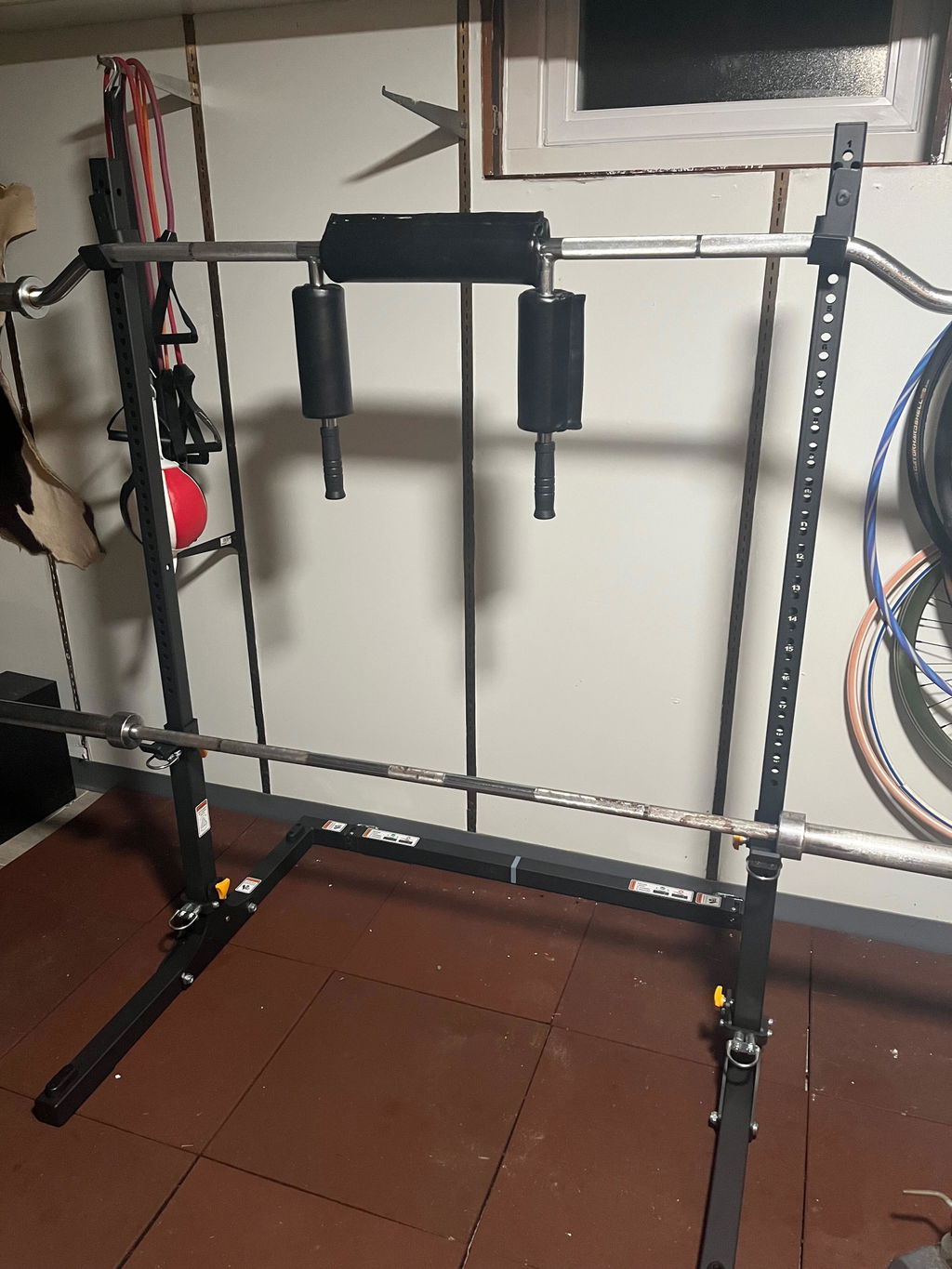
The Hatfield Bulgarian split squat removes a lot of that nonsense. Put a safety squat bar on your back. Put your rear foot on a bench. Hold onto the rack to use your hands to stabilize yourself while putting the majority of the loading demand where you actually want it: on the working leg.

This is one of those cases where making an exercise "easier" actually makes it more useful. The rack isn't cheating; it's support, which allows you to put more effort into the muscles of the working leg rather than spending half your concentration trying not to fall over. This also makes the exercise particularly useful for someone who doesn't tolerate bilateral back squatting very well.
You might find that you can perform a split squat comfortably even though a conventional back squat bothers your knees or back. If the Bulgarian split squat does agree with you, the Hatfield version gives you an incredibly stable platform from which to progressively load it, which means you can make the exercise brutally heavy without turning it into a balance competition.
3. Weighted Walking Lunges
Walking lunges are probably the least complicated exercise on this list, which is one of the reasons I like them. They train the quads, glutes, and hamstrings while forcing you to control your body as you move through space and, unlike a stationary split squat, you're actually going somewhere, which mimics those other somewhat common unilateral movements like walking, running, climbing stairs, or, a big one for longevity, getting off of the floor.

You don't need much equipment, either. Bodyweight works, dumbbells work; kettlebells work; barbells work if you've got the space and the skill to use them safely, and if you don't have enough room to walk back and forth across your basement, garage, or living room, you can always use reverse lunges instead.
The biggest reason I like unilateral training is simple: It gives you options. Let's say your normal lower-body workout options look something like this:
- Back squat
- Romanian deadlift
- Leg curl
That's a perfectly respectable workout. But what happens when your knee doesn't like the back squat? If that's your entire lower-body exercise pool, you've got a problem.
Now compare that with:
- Back squat
- Safety Bar Hatfield Bulgarian split squat
- Single-leg RDL
- Walking lunge
- Romanian deadlift
Suddenly, one exercise not working doesn't bring your entire lower-body training program to a screeching halt. You can train around an irritated joint without simply deciding that leg day is canceled.
This variety is particularly important for people training at home. To get strong, you need a relatively small number of good exercises that you can progressively overload and manipulate in different ways. A barbell and a rack give you a tremendous number of options and adding unilateral variations gives you even more.
I've always thought that strength training should make you more capable, not less. And that means having more than one way to train a muscle. The back squat is a fantastic exercise but it's not the only way to train your legs. If you enjoy back squatting and your knees tolerate it well, keep squatting. If you're trying to get as strong as possible at the squat, you should absolutely spend a good amount of time squatting. For the rest of us, there are other options. In fact, even for the future world record holder, I would argue that most people would benefit from having several single-leg movements in their exercise library whether they use them every week or not.