THE EASIEST STRENGTH—How to Progress by Taking it Easy
By Shane Robert
I have made no secret that I have been heavily influenced by coaches Dan John and Pavel Tsatsouline. Both as individuals and as a writing team in their work “Easy Strength.” Reading that book was paradigm-shifting for me the first time I read it. I had never considered that you could make progress (and significant progress) with “easy” training. That is to say, you don’t have to push to failure, get psyched up, strain, do a ton of sets, create a ton of muscle soreness, etc. This was so different from what I was used to that I was skeptical that it would work. Despite my misgivings, I tried it. And it worked. Indeed, it worked very well.
Much of the benefit from this type of training comes from lowering overall fatigue while increasing movement efficiency. You get to practice the chosen movements (more on that later) with a high frequency using light enough weights to move them with great force and perfect form, but heavy enough to impart neurological adaptations and maybe some muscle gain. Running a cycle or a few per year is a great break for heavy lifters without any real loss of strength; it’s great for an in-season athlete; it’s great for someone looking for general fitness.
My version of Easy Strength, heavily influenced by Dan John’s “Even Easier Strength” article, prescribes specific percentages of 1RM. This differs from the original protocols. However, I find it necessary when working with remote clients. First, they expect some kind of weight listed on their sheet; second, it helps me stop them from training too heavy. I would notice, even with calling for low RPE ratings, that the weight would still be too heavy. It’s okay if the weight feels easy; that’s the point. But it should never feel slow, grindy, or at risk of missing a rep. Therefore, the one caveat is: it’s okay to lower the weight on a day if it feels heavy/slow.
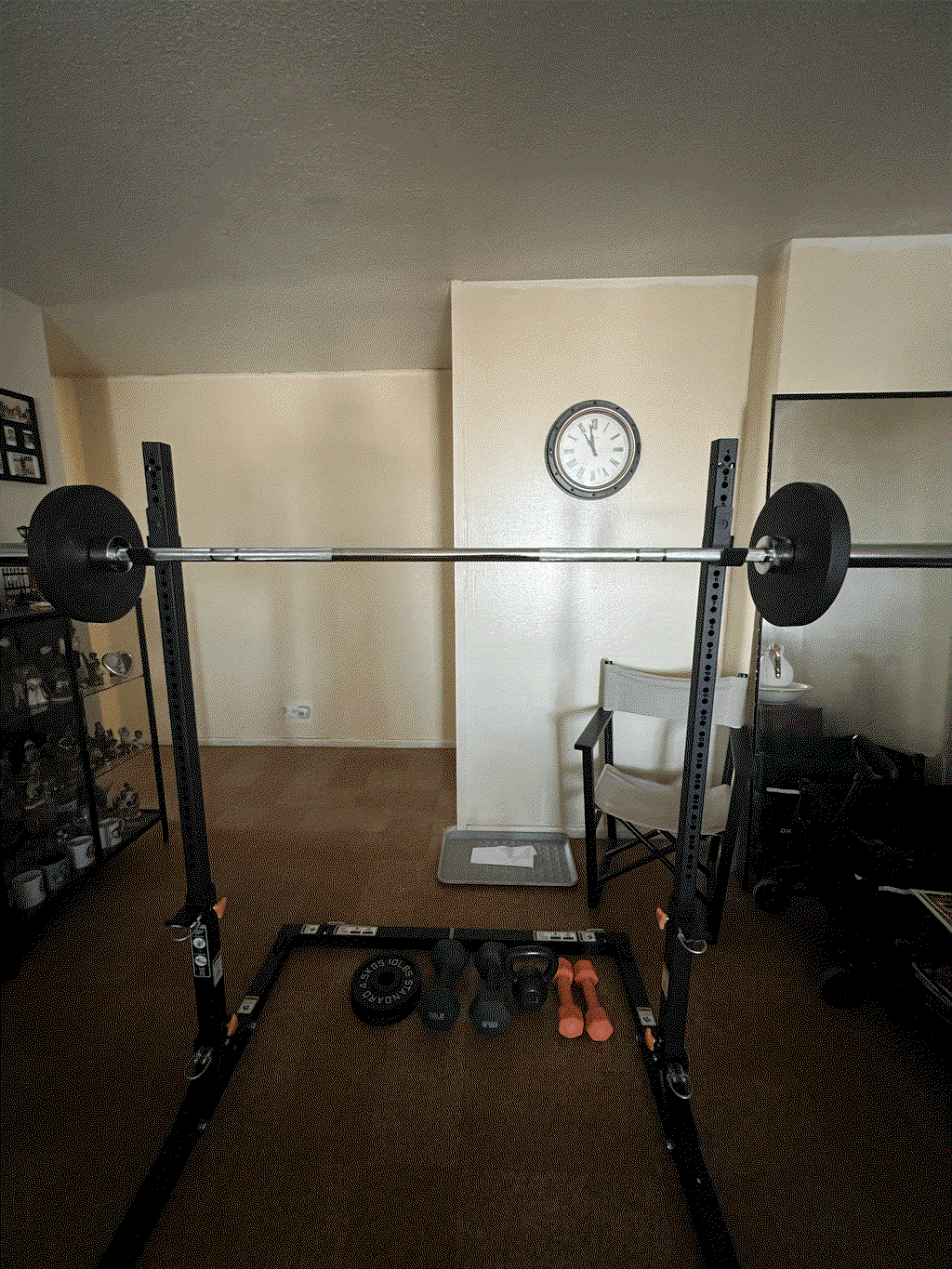
The program runs 6 days per week. The sessions are—say it with me now—EASY. So you can get away with this kind of frequency. The sessions are quite fast, often as little as 20 minutes, so most people can find the time to do it, especially with some kind of home gym setup. The cycle lasts 2 weeks, or 12 workouts, and then repeats the same sequence two to three more times (for a total of 6-8 weeks) with the weights bumped up 5% each time.
Here is the basic layout:
WEEK 1
WEEK 2
As far as exercise selection goes, you can choose any number of movements, from 2 to 10 if you wish, though this works best with bigger barbell-based movements. I tend to prescribe variations of the basic movement patterns - squat, push, pull, hinge (note: I leave single leg out, but you can feel free to include it). A basic lineup might be:
- Squat variation
- Press variation
- Pull Up variation
- Deadlift variation
However, since these are such fast sessions, there is no reason that you can’t include vertical and horizontal variations of push and pull each day as well.
A way to structure your training for a longer-term plan would be to start with harder variations of the main movements and work your way to harder variations. An example for deadlifts might be something like:
Snatch Grip Deadlift → Deficit Deadlift → Regular Deadlift
Since this does feel like a lot of work, I will allow clients to start each session with 50-100 kettlebell swings, finish three sessions per week with 3 sets of 10 of arm work (no more than an RPE of 6-7), and or bodyweight movements. This can be 1 set of 3 different exercises or 3 sets of 1 exercise.
This type of training has to be tried to be believed. The first time I did this was during the COVID lockdowns. I ran a variation of this layout using buffalo bar bench presses. I never touched more than 245 in training and was able to casually bench 310 on the buffalo bar for a single.